Greek Space Tech forum 2026 - Report

The “next day” for Greek reality, as shaped by our country’s enhanced presence in Space, was at the center of the Greek Space Tech Forum 2026 – #gstf26, which took place with great success and massive participation on Tuesday 7 and Wednesday 8 July 2026.
#gstf26 was co-organized by ethosEVENTS, the Hellenic Space Technologies and Applications Industry Association (HABI), the Space Technologies and Applications Cluster (si-Cluster), coordinated by Corallia, and the European Space Agency Business Incubation Centre in Greece (ESA BIC Greece), under the auspices of the Ministry of Digital Governance and the Hellenic Space Center (HSC).
Participation in the event was hybrid, with physical presence at the Athens Conservatoire (Odeion Athinon) and online through the LiveOn Expo Complex, the innovative 3D exhibition and conference center of LiveOn, the digital Business Communication and Events platform.
The Forum gathered executives from the European Space Agency (ESA), the European Defence Agency (EDA), the European Commission (DG DEFIS, EUSPA), as well as high-level representatives of the Greek government, the academic and research community, industry, startups, and the broader Greek and European space ecosystem, aiming to analyze the opportunities and challenges for the further development of Greece’s presence in Space.
#gstf26 took place during a landmark year, as Greece is implementing the National Microsatellite Program with the launch of 24 satellites, while at the same time celebrating 20 years of the country’s participation in ESA and 5 years of operation of ESA BIC Greece, and following the recent announcement of the continuation of the Greek Space Program for the period 2026-2031 with a budget of €350 million.
With more than 70 speakers across 12 panels and over 30 keynote speeches, the conference program covered the most important developments in the Space sector, such as the country’s new operational space capabilities, Earth Observation and Artificial Intelligence applications, defense and strategic autonomy, civil protection, shipping, environment, agriculture, funding of the space economy, space startups, research, international partnerships, and opportunities for the new generation of scientists.
It should be noted that the Greek Space Tech Forum 2026 evolved into a comprehensive institution combining both a conference and a space technology exhibition. Within the framework of the two-day conference, presentations by startups, an exhibition of technological solutions, and sponsored side events took place, offering a unique experience for participants. The first day of the conference concluded with the celebration of 5 years of operation of the European Space Agency Business Incubation Centre (ESA BIC Greece), which provided support and seed funding to Greek startups in the space technology sector.
In the framework of #gstf26, B2B Meetings and many Parallel Actions took place:
B2B Meetings
The Greek Space Tech Forum 2026 offered a unique networking opportunity through B2B meetings: in-person, on July 7 and 8, and digital meetings, on July 9 and 10, via the LiveOn Expo Complex.
Satellite presentations – Innovation area
As part of the event, a dedicated parallel presentation hall operated for the event sponsors, where, on the first day, major sponsor companies presented their innovations in the sector, while on the second day, a stage was provided to highlight new ideas and technologies for Space Tech Startups.
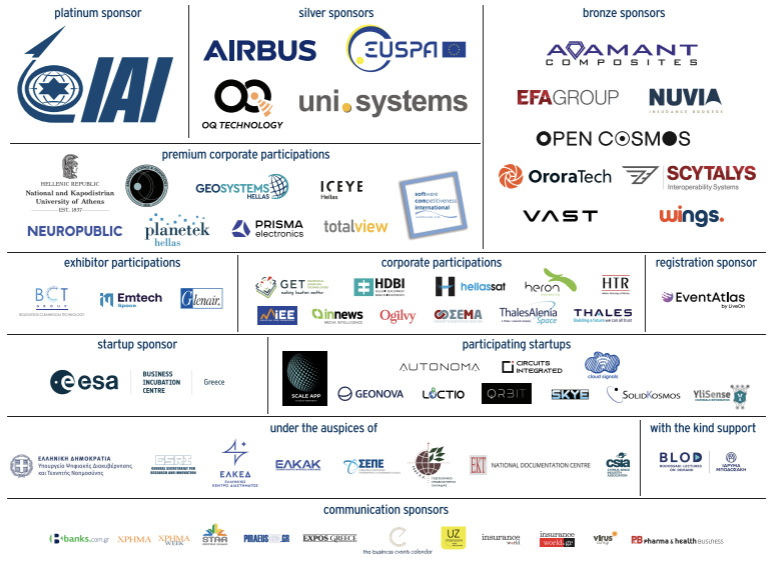
We would like to warmly thank the companies that sponsored the conference, all the entities that granted us their auspices, as well as all participants!
Sincerely,
Konstantinos Ouzounis
CEO, ethosGROUP
SOCIAL
522 attendees
150+ press releases
87.000+ impressions
The Greek Space Tech forum 2026 was held hybrid, at the Athens Conservatoire and digitally streamed from the LiveOn Expo Complex, the innovative 3D exhibition and conference centre of LiveOn, the digital platform for Business Communication and Events.
Relive your visit to the LiveOn Expo Complex by clicking on the following photo.

Opening Remarks
Opening Remarks
Konstantinos Ouzounis, CEO, ethos GROUP
Mr. Ouzounis gave the opening remarks of this year’s Forum.
Welcome Address
Athanasios Potsis, Chairman, Hellenic Association of Space Industry
The Forum’s proceedings were opened by Mr. Potsis, who highlighted the efforts to foster cooperation between industry and universities. As he noted, among other things, their goal is to build industrial capacity for the country, which represents a strategic asset.
He pointed out that developing a product for the space sector, particularly in a country without an established tradition in the field, requires demonstrating the ability to develop and manufacture technology. He further stressed that the most important role of the space industry is to enable the transfer of systems and innovation across different sectors, concluding that “Space is defence, and defence is space.”
Welcome Address
Jorge-A. Sanchez-P., Chairman, si-Cluster & Director, ESA BIC Greece, Corallia
In his greeting, Mr. Jorge-A. Sanchez-P. mentioned that Greece is no longer discussing theoretically whether it can play a role in Space—it is already in orbit, and the question now is how we will turn this orbit into a lasting strategic impact. As he noted, the recent announcement of the new HELLAS-SPACE 2.0 program sends the message that the country does not view Space as a fragmented effort, but as a national strategic choice and a continuous path. For him, as he stated, the challenge of the “next day” for Greece is clear: to proceed with consistency, to increase our participation in European programs, to make the most of the new 2.0 national program, to provide our companies with more opportunities, and to connect startups and SMEs more systematically with international clients, investors, and industrial partners.
Institutional Greeting
Dimitris Papastergiou, Minister of Digital Governance and AI, Hellenic Republic
In his address to the event, Mr. Papastergiou noted, among other things, that Space has come to fill auditoriums, while on the day of the conference, the launch of the 18th microsatellite also took place. As he stated, in 2023, they inherited a program that needed to be modified, and they managed to carry it through to completion. He emphasized that, as a country, we are beginning to provide solutions to engineering challenges, addressing real-world problems and offering solutions in areas such as civil protection, while now actively participating in microsatellite constellations. He concluded by stressing that Greece is not merely observing developments, but actively participating in them.
Institutional Greeting
Konstantinos Kyranakis, Secretary General of New Democracy
A institutional greeting was delivered by Mr. Kyranakis, who emphasized, among other things, that being there brought a sense of nostalgia, as he spent a year at the Ministry of Digital Governance working on the Space program. As he noted, he feels very proud that together they have successfully managed to put 18 satellites into orbit, acquiring expertise and building an ecosystem that is constantly growing. He added that this is a dynamic sector of the economy, and everyone understands the vital assets Greece has now acquired, such as Firewatch.
Institutional Greeting
Simonetta Cheli, Director of EO Programmes, ESA
In a video address, Ms. Cheli highlighted that Greece’s contribution to the recent ESA Council at Ministerial Level was truly historic. As she noted, the foundations have now been laid for an exciting future, full of opportunities for the entire Greek space sector. She added that ESA’s Directorate of Earth Observation Programmes is particularly proud to support the Greek national program, which is progressing extremely well, with tangible and measurable results. As she characteristically stated, our joint achievements demonstrate that European cooperation can transform innovation into operational capability.
Session I - Greece in Orbit: Operational Space Services & Capabilities
Keynote Speech
Dominique Gillieron, Head of Earth Observation Projects Department, ESA
Mr. Gilliéron stated that he has been a “space person” for 30 years and has been implementing projects within space programs for the last 20 years. As he described, he is currently responsible for 28 projects, with the Greek national program being one of them—progressing at the fastest rate of implementation and standing out most for its dedication and determination in achieving its milestones. He then analyzed the 4 key elements that define the success of any national program: 1) that the program must be sufficiently ambitious, 2) that a coherent connection must be created across the value chain (upstream & downstream), 3) the presence of a realistic implementation plan, and 4) long-term commitment.
Greek Operational Satellites
Panel Moderator: Stelios Bollanos, CEO, Planetek Hellas
- Dominique Gillieron, Head of Earth Observation Projects Department, ESA
- Maria Kalama, Managing Director, Open Cosmos Aegean
- Vasilis Chaloulakos, CEO, ICEYE Greece
- Ioannis Lantouris, Managing Director, OroraTech Greece
Session II - Greece in Orbit: Emerging Space Services & Capabilities
Keynote Speech
Dimitris Bliziotis, Scientific Officer, Hellenic Space Center
Mr. Bliziotis spoke about the €130 million segment of the National Satellite Program, which focuses on Earth observation. Expressing his satisfaction regarding the launch of the first optical satellite, he noted that the objective is to strengthen national manufacturing—not merely purchasing satellites, but actively investing in and building critical components and systems within Greece.
Keynote Speech
Dimitris Christopoulos, Scientific Officer, Hellenic Space Center
Mr. Christopoulos spoke about the emerging services and applications of the national program in secure satellite communications. Within the framework of the broader strategy for secure connectivity in our country, he structured his address around 3 key pillars: the operational connectivity management for national users, active participation in major European secure connectivity programs, and the reinforcement of Greece’s position in Space through the utilization of national assets.
Keynote Speech
Frederic Rouesnel, Head of the Resilience Initiatives Implementation Management Office at the European Space Agency
In his speech, Mr. Rouesnel also referred to the program’s achievements and the lessons learned as a team. As he noted, among other things, they worked in the spirit of exploring new space opportunities, investigating prospects in telecommunications and Earth observation for the Greek citizen. This was the program’s motto.
Keynote Speech
Omar Qaise, CEO, OQ Technology
Mr. Qaise spoke about the importance of European sovereignty in Space, as Europe currently relies heavily on non-European infrastructure for satellite communications. As he explained, this constitutes a strategic vulnerability because, with low Earth orbit satellite communications, all future notification systems will be connected to these infrastructures, and not owning them means outsourcing this strategic importance to other countries.
Panel Moderator: Dimitris Bliziotis, Scientific Officer, Hellenic Space Center
- Svein Lokas, Head of the Hellenic Earth Observation SmallSats Program, ESA
- Stelios Bollanos, CEO, Planetek Hellas, Optisat Mission
- Omar Qaise, CEO, OQ Technology, ERMIS Mission
- Vaios Lappas, Professor, National and Kapodistrian University of Athens, ERMIS Mission
ERMIS Mission
Panel Moderator: Dimitris Christopoulos, Scientific Officer, Hellenic Space Center
- Frederic Rouesnel, Head of the Resilience Initiatives Implementation Management Office at the European Space Agency
- Alkiviadis Chatzopoulos, Professor, Aristotle University of Thessaloniki, PeakSat Mission
- Dimitra-Marina Giordamli, Corporate Affairs, Prisma Electronics, MICE-1 Mission
- Nikos Livanos, CEO, Emtech Space, HELIOS & SELENE Mission
Session III - 20 years of Greece in ESA – Building the Next Space Decade
Keynote Speech
Emmanuel Rammos, President, Hellenic Space Center
Mr. Rammos presented Greece’s trajectory in Space and its cooperation with the European Space Agency (ESA). As he noted, Greece’s relationship with Space began prior to its accession to ESA in 2005, starting with the construction of the first satellite station in 1970 and its participation in international telecommunications organizations. Initial contacts with ESA began in 1990, leading to the signing of a cooperation protocol in 2001 and, ultimately, to Greece’s full accession as its 16th member state in 2005. Since then, Greek industry and scientists have actively participated in ESA programs, developing expertise and products. Among key milestones, he highlighted the launch of the first Greek satellite in 2003, the establishment of the HSC (Hellenic Space Center) in 2019, the upcoming mission of the first Greek astronaut, and the recent €200 million funding for the development of the space ecosystem.
Keynote Speech
Athanasios Potsis, Chairman, Hellenic Association of Space Industry
Mr. Potsis highlighted ESA’s role in the development of the Greek space industry. As he emphasized, Greece’s participation in ESA was due to the forward-thinking decision made twenty years ago by academics, rather than the industry itself. He noted that the obligation to manufacture significant products brought dynamic growth, in contrast to other European programs. Among other points, he pointed out that ESA trained the Greek industry, providing invaluable expertise, while developing and maintaining infrastructure and relationships with major European companies. With an increased budget now in place, he concluded, Greece possesses the trademark “Space Technology Made in Greece,” the capability to manufacture space hardware, and a national space surveillance system.
Greece 20 years in ESA
Panel Moderator: Athanasios Potsis, Chairman, Hellenic Association of Space Industry
- Emmanuel Rammos, President, Hellenic Space Center
- Christina Giannopapa, Head of the Office of the Executive Director, EUSPA
- Ioannis Daglis, Professor, National and Kapodistrian University of Athens
- Betty Charalampopoulou, Director, EARSC – President & CEO, Geosystems Hellas
Session IV - ESA BIC Greece at 5 years – Building Greece’s New Space Economy
Keynote Speech
Stavros Kalafatis, Deputy Minister of Development, Hellenic Republic
Mr. Kalafatis referred to our country’s transition from a passive consumer of services into an active, internationally competitive producer of cutting-edge technology. The Deputy Minister presented the impressive official figures of ESA BIC Greece, which has supported a total of 32 startups, while praising the ecosystem’s unique sustainability rate, as 24 out of the 25 evaluated companies remain fully active, having already generated €5.3 million in revenue, €2.7 million in additional public funding, and 90 permanent jobs. At the same time, he referred to the new four-year extension of the incubator, featuring increased funding of €80,000 per startup and marking its first call for proposals in October 2026.
Keynote Speech
Nick Appleyard, Head of Applications and Solutions Department, European Space Agency (ESA)
Mr. Appleyard noted that ESA currently operates 40 startup incubators supporting more than 2,300 startups, which corresponds to approximately 300 new startups per year. He made special reference to the decision to establish the Greek incubator five years ago and the spectacular results achieved through its operation, while highlighting the broad spectrum of services and expertise covered by the participating companies. As he stated, ESA’s BIC system generates significant value for the economy, pointing to over €1.25 billion in private investments during the 2020–2023 period and €232 million in revenue in 2023, along with more than 5,000 full-time jobs in that specific year.
Keynote Speech
Jorge-A. Sanchez-P., Director, ESA BIC Greece, Corallia
Mr. Jorge-A. Sanchez-P. noted that ESA BIC Greece constitutes a key mechanism through which Greece is building its new space economy. He emphasized that the program has supported 32 space startups, contributing to the country’s transition from participating in European space actions to creating substantial national capabilities. He also highlighted that ESA BIC Greece has contributed to the creation of new companies, the transfer of technology from research to the market, the reconnection of Greek talent with the country, as well as the generation of business activity exceeding €8 million and more than 90 jobs. In closing, he noted that the next phase, for the 2026-2032 period, is scaling up: more ambitious startups, stronger connection with ESA and European markets, increased investments, and even greater international outreach.
Panel Moderator: Jorge-A. Sanchez-P., Director, ESA BIC Greece, Corallia
- Nick Appleyard, Head of Applications and Solutions Department, European Space Agency (ESA)
- Nikos Vogiatzis, Partner, Corallia Ventures
- Paolo Fioravanti, CEO, Circuits Integrated Hellas
- Dimitris Agiakatsikas, CEO, SolidKosmos
- Salvator Levis, Executive Member of the Board of Directors, 5G Ventures
DAY 2 - Wednesday, 8 of July 2026
Session V - Space, Defence & Strategic Autonomy
Keynote Speech
Georgios Panousis, Major General, Director of the 6th Branch of HNDGS
Mr. Panousis, among other points, stated that we are at a critical geopolitical turning point and that deterrence is not limited to the battlefield, but extends across all arenas of confrontation that rely on data and depend on domain advantages—and that domain is Space. He went on to say that the Armed Forces will not merely adapt to the future, but will actively shape it. As he emphasized, in the past, Space was considered a luxury and a purely scientific field, whereas today it constitutes an operational necessity; true strategic autonomy cannot be achieved when relying on others.
Keynote Speech
Ioannis Bouras, Major General, General Director of GDDIA
Mr. Bouras noted, among other things, that Space constitutes a critical infrastructure, a source of data, a communication network, and a means of navigation and precise timing. As he emphasized, it serves as a tool for surveillance, early warning, and decision-making, acting as a power multiplier for defense while simultaneously representing a domain of economic growth and technological innovation. Furthermore, he placed particular emphasis on SAFE, which introduces a new dimension. As he stated, the Greek planning for SAFE includes two programs with a clear space dimension: the first concerns secure satellite communication capabilities, and the second involves microsatellite Earth observation capabilities using Synthetic Aperture Radar technology—commonly known as SAR.
Panel Moderator: Dimitris Mallas, Journalist
- Niko Adamsky, Business Development and Marketing Manager, Space Division, Israel Aerospace Industries (IAI)
- Thomas Kalamaris, Ground Segment & Mission Operation Architect, EFA GROUP
- Sofia Mitoulaki, Technical Sales Lead, ICEYE Hellas
- Antonios Vavouliotis, CEO & Co-founder, Adamant Composites
- Betty Charalampopoulou, President & CEO, Geosystems Hellas & EARSC Director
Session VI - Funding Europe’s Defence and Dual-Use Innovation Ecosystem
Keynote Speech
“Greek Investments in space”
Pantelis Tzortzakis, CEO, Hellenic Centre for Defence Innovation
According to Mr. Tzortzakis, Space for Greece is not just about satellites, but about maritime domain awareness in the Aegean and Eastern Mediterranean, civil protection against wildfires, floods, and extreme weather phenomena, secure communications, and the protection of ports, islands, energy grids, critical infrastructures, and military installations. From the very beginning, as he noted, ELKAK decided that space capabilities must form an integral part of defense innovation challenges and projects, which is why they proceeded with the pilot development of an ISR microsatellite equipped with SAR—meaning radar—to support maritime surveillance and border monitoring.
Keynote Speech
Christos Ampatzis, Policy Officer, European Commission DG Defence Industry & Space (DEFIS)
Mr. Ampatzis presented the approach for promoting dual-use research and innovation, primarily from the perspective of Space. As he noted, the European Space Shield constitutes the architecture currently being discussed with Member States to connect European programs, research and innovation actions, national initiatives, and commercial capabilities into a coherent system. He further mentioned that the European Commission has set the goal of conducting a pilot mission by 2030, in cooperation with Member States and the European Space Agency, as a first step towards creating a future European in-space servicing infrastructure.
Keynote Speech
Eleni Patouni, Project Officer Space Technologies, CapTech Space Moderator, European Defence Agency (EDA)
As Ms. Patouni emphasized, Europe cannot treat innovation in Space and Defense as separate worlds. Referring to the distinct role of the EDA (European Defence Agency), she highlighted that it serves as the forum where Member States identify common military requirements, set priorities, develop collaborative projects, and connect defense policymakers with technology communities. Describing EDA’s CapTech Space, which she coordinates, she pointed out that it directs cooperation between Member States and industry for R&D development regarding space defense.
Panel Moderator: Maria Mavridaki, EU Policy – Governmental affairs analyst
- Pantelis Tzortzakis, CEO, Hellenic Centre for Defence Innovation
- Christos Ampatzis, Policy Officer, European Commission DG Defence Industry & Space (DEFIS)
- Eleni Patouni, Project Officer SpaceTechnologies, CapTech Space Moderator, European Defence Agency (EDA)
- Stelios Bollanos, CEO, Planetek Hellas
Session VII – Human Spaceflight and Science Missions
Fireside chat:
- Anezina Solomonidou, Planetologist, Scientific Officer at HSC, Delegate of Greece to ESA in Human and Robotic Exploration
- Adrianos Golemis, Astronaut in Training, MEDES / ESA / Hellenic Space Center
In the context of the fireside chat with Ms. Solomonidou, Adrianos Golemis was hosted as the first Greek participating in an official astronaut training program of the European Space Agency (ESA).
Ms. Solomonidou referred to the Greek presence in space exploration and the upcoming steps being prepared for human spaceflight missions, while presenting characteristic examples of Greek participation through scientists and organizations in both ESA and NASA. Among other points, she also highlighted the connection between research and industry, as well as industry with major missions, emphasizing the role of the HSC (Hellenic Space Center) in facilitating this successful interconnection.
Mr. Golemis suggested, among other things, focusing on two or three key elements. In Europe alone, the return on investment in the space research sector is estimated at approximately 3.5 to 4 to 1, whereas in the United States, the yield is even higher.
Keynote Speech
Giorgio Saccocia, President Europe, Vast
Mr. Saccoccia presented Vast, which aims to fill the gap that will be left by the decommissioning of the International Space Station by providing commercial infrastructure in low Earth orbit. As he explained, the company has grown rapidly and is adopting a phased approach, proving its capabilities through successful milestones such as the Haven Demo demonstration satellite. Next year, as he stated, Vast will send astronauts to the International Space Station via the PAM-6 mission and will launch the first module of its own private space station, Haven-1, which will host 4 astronauts for two weeks, offering opportunities for scientific experiments and high-speed Starlink connectivity.
Session VIII - Space Diplomacy and Strategic Cooperation
Keynote Speech
Christina Giannopapa, Head of the Office of the Executive Director, EUSPA
Ms. Giannopapa initially presented the European space program based on its key pillars: navigation (Galileo and EGNOS), Earth observation (Copernicus), telecommunications (GOVSATCOM and IRIS²), and Space Situational Awareness. Subsequently, she explained the role played by EUSPA within the program, focusing on security, utilization, and exploitation of space systems, services, and data. Furthermore, she invited the audience to participate in the User Consultation Platform in Prague and the free e-learning platform EU Space Academy, as well as to stay thoroughly informed on market developments through the agency’s Market Report and newsletter.
Keynote Speech
Danilo Rubini, Head of the Office for Relations with the EU, Italian Space Agency
Mr. Rubini presented Italian space activities from the perspective of strengthening cooperation with Greece. Regarding ASI, he mentioned, among other points, that it was founded in 1988, employs over 450 people, and operates at national, bilateral, and international levels. As for the Italian space industry, he stated that it comprises more than 300 companies, 23,000 employees, 15 technology centers, and other entities, featuring a strong representation of SMEs and startups. Finally, he highlighted the signing of a Memorandum of Understanding between ASI and the HSC (Hellenic Space Center) and the recent Greek-Italian dialogue at the ministerial level regarding digital and space cooperation.
Keynote Speech
Ewa Pańczak, Deputy Head of Mission, Embassy of the Republic of Poland in Athens
A significant part of Ms. Pańczak’s speech focused on Poland’s close cooperation with Greece in the space sector. As she mentioned, companies such as Creotech Instruments are participating in joint Earth observation initiatives, developing international satellite constellations, and discussing inter-satellite optical communications aimed at expanding capabilities across Europe, while plans are underway to establish a factory in Greece. Furthermore, ICEYE, co-founded by a Polish entrepreneur, is a key partner in the Greek microsatellite program and has opened a satellite assembly facility in Athens.
Keynote Speech
Diofantos Hadjimitsis, Full Professor, Department of Civil Engineering and Geomatics, Faculty of Engineering and Technology & Managing Director, Eratosthenes Centre of Excellence, Cyprus University of Technology (CUT)
Mr. Hadjimitsis presented the 20-year history and activities of the laboratory in the fields of Earth observation, navigation, and space technology. Among other points, he referred to the Excelsior project, a €38 million investment aimed at upgrading the laboratory into a center of excellence, as well as its international partnerships and the installation of critical infrastructures, such as the national incubator and the calibration/validation site for atmospheric sciences.
Keynote Speech
Antonis Tzortzakakis, Chief Executive Officer, 5G Ventures
Mr. Tzortzakakis presented the Phaistos Investment Fund, a venture capital fund that has established an ecosystem of 13 partner networks with universities and research centers. Regarding the Space sector, he emphasized that Phaistos represents a strategic priority and its largest investment. He then discussed the two space companies they have invested in: OQ Technology, which is developing “made in Greece” satellites for 5G IoT non-terrestrial networks, and D-Orbit, one of Europe’s leading companies in the field, specializing in downstream applications, image analysis, and Earth observation.
Session IX - Earth Intelligence, Environment, AI & National Data Infrastructure
Keynote Speech
Kostas Pilaftsis, Business Development Manager, Planetek Hellas
Mr. Pilaftsis described the transition from simple observation to Earth awareness as an integrated operation combining four key elements: the environment, data collection capabilities (remote sensing and in-situ), data infrastructure, and artificial intelligence—with the fifth element being the human aspect that provides meaning and operational intent. To fully leverage these capabilities, he concluded, data governance and the adaptation of the regulatory framework are critical.
Keynote Speech
Antonis Cassano, Business Development Director, Uni Systems – President & Founder, Pleiades Innovation Ecosystem
Mr. Cassano offered the perspective of a major system integrator regarding the market in question, evaluating its trajectory so far, highlighting opportunities, and identifying the creation of ecosystems as a key priority. He pointed out that Europe is rewriting the rules in the space economy and that Greece has made significant progress with the RRF program, the National Microsatellite Program, the Hellenic Fire System, and Open Cosmos. As he stated, Uni Systems can contribute significantly, but the ecosystem requires collaboration in the field of geospatial information and satellites, where the company is partnering with GET.
Panel Moderator: Kostas Pilaftsis, Business Development Manager, Planetek Hellas
- Stylianos Sakaretsios, Secretary General for Transportation, Hellenic Republic
- Maria Kalama, Managing Director, Open Cosmos Aegean
- Paschalis Veskos, Head of Space Industry Projects, Softcom International
- Vana Giavi, Managing Director, Totalview
Session X - Space Applications for Climate, Civil Protection & Maritime Resilience
Keynote Speech
Panagiotis Demestichas, Chairman, WINGS ICT Solutions
Mr. Demestichas noted that, until now, the applications they have developed are provided primarily up to ground networks. As he stated, they are participating in the conference because they believe in the synergies that can be developed with companies growing in the Space domain, across all sectors in which they operate. Subsequently, he presented the platform offered by the company along with all the applications it provides and operates, relating to wildfires, irrigation, floods, power pylons, transportation, health, telecommunications, and more.
Panel Moderator: Dimitris Mallas, Journalist
- Prasanna Nagarajan, CTO, OQ Technology
- Christos Giordamlis, Managing Director, Prisma Electronics
- Ioannis Bligiannis, Lead System Engineer - Space & Defense Program, EFA GROUP
- Georgios Exarchou, Founder & CEO, Pollux Tech
Session XI - Space Applications for Agriculture, Environment & Smart Territories
Keynote Speech
Ioannis Andrianos, Deputy Minister of Rural Development and Food, Hellenic Republic
Mr. Andrianos noted that, until recently, the field and Space were two distant worlds; however, today we know that a dynamic ecosystem has been established in Greece to enhance state capabilities across every domain of action. As he pointed out, this effort is entering its next, even more ambitious phase, confirming that space technology constitutes a strategic choice. He added that in the primary sector, these applications have already begun to transform the landscape: prevention, mitigation, targeted water usage, a smaller environmental footprint, better organization, and resilience.
Panel Moderator: Ioannis Gitas, Professor, Aristotle University of Thessaloniki
- John Mavroudis, Managing Director, Neuropublic
- Georgios Fotopoulos, Team Lead & Business Development Manager, OroraTech
- Kleanthis Karamvasis, CEO, Moistx
- Elisavet Parselia, CTO, Geonova
Session XII - Financing and Scaling the Greek Space Economy
Closing Remarks
- Athanasios Potsis, Chairman, Hellenic Association of Space Industry
- Jorge-A. Sanchez-P., Director, ESA BIC Greece, Corallia
Mr. Potsis observed that we have a very dynamic, integrated environment that encompasses all the value chains supporting a country’s space activity and ecosystem. Referring to the Ministry of National Defence, he stated that it represents a major goal for the MND to open its structures to industrial cooperation, requiring the adoption of the same scenarios and procedures that have been successfully applied thus far. For the coming year, he set the objective of integrating the Cypriot space industry with the Greek ecosystem, as well as connecting Greeks worldwide, noting that their expertise and experience are such that, if fully leveraged, will yield remarkable results.
For his part, Mr. Sanchez-P. noted that the goal is to make the event somewhat more international, while also focusing on dual-use defense, which is highly significant for the country. As he announced, strategically, in the coming period, there will be a lot of news regarding downstream applications (new solutions, new problems being addressed, new time-series data, etc.), whereas next year the design of the new Hellas Space 2.0 program will take center stage. Finally, he suggested that major industry players find ways to foster their growth through acquisitions of smaller or even larger companies, merging with them to bring complementarity to their operations.
SPONSORS
EVENT ORGANIZING TEAM
For information on sponsorship programs
Konstantinos Ouzounis, CEO, ethosGROUP
tel:+30 210 998 4864,
e-mail: [email protected]
Thanos Psycharis, Chief Commercial Officer,
Tel:+30 210 998 4903,
e-mail: [email protected]
Rando Manologlou, Key Account Manager,
tel: 210 998 4863,
e-mail: [email protected]
Stavroula Oikonomaki, Key Account Manager,
tel: 210 998 4876,
e-mail: [email protected]
Loretta Boura, Key Account Manager,
tel: 210 998 4902,
e-mail: [email protected]
For information on the program & Auspices
Mariana Vazaiou, Events Content Director,
tel:+30 210 998 4932,
e-mail: [email protected]
Stamatina Farkona, Events Content Senior Manager,
tel:+30 210 998 4933,
e-mail: [email protected]
Marketing & Communication Sponsors
Fotini Tourli, Marketing & Communications Specialist,
tel:+30 210 998 4934,
e-mail: [email protected]
Anastasia Binikou, Junior Marketing Assistant,
tel:+30 210 998 4905,
e-mail: [email protected]
Event Coordinator
Konstantinos Salvarlis, Events Director,
tel:+30 210 998 4909,
e-mail: [email protected]
Aris Lavdis, Associate Director, Events,
tel:+30 210 998 4814,
e-mail: [email protected]