The 2nd Greek Water Summit is an established dialog forum for developments, challenges, and prospects shaping the water sector in Greece. In a period where water resource management is becoming increasingly important, the Conference aims to serve as a meeting point for the State, Local Government, the scientific community, and the market.
The Conference focuses on the broader framework of sustainable water management, taking into account the impacts of climate change, rising consumption demands, and the challenges faced by existing infrastructure. At the same time, it highlights the importance of strategic planning, system resilience, and the balance between social, environmental, and development needs.
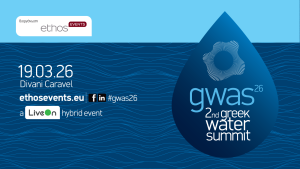
The 2nd Greek Water Summit will take place on March 19, 2026, and is organized by ethosEVENTS, in collaboration with the financial and business portal banks.com.gr and the financial and investment magazine HRIMA. Participation in the conference will be possible with physical presence at the Divani Caravel Hotel, as well as online via the LiveOn Events+ platform.
Among other things, the Conference will feature keynote interventions and thematic roundtable discussions (panels) covering the following core areas:
Theme 1: Pressurized Water – Reserves, Water Scarcity, and the State of Emergency in Attica
The first panel presents the current state of water reserves, with an emphasis on the resilience of the Attica water supply system and management limits. How much did the rainfall/snowfall change the situation? What does the “state of emergency” mean in practice and whether it will be extended with a new ministerial decision.
Theme 2: Water, Climate Crisis, and the State
The second panel presents the role of the state in water management under the weight of the climate crisis and the stake in its public character, against the backdrop of water scarcity, infrastructure delays, and the real cost that is passed on to tariffs and society.
Theme 3: Tourism and Water – Development Without Sufficiency?
The third panel discusses tourism as a major water consumer during peak seasons and the resilience of local infrastructure. Islands and popular destinations are at the heart of increased demand, with the conflict between tourism development, water availability, and the long-term sustainability of local ecosystems emerging as a critical issue for the future.
Theme 4: Industry, Agriculture, Energy, and Water – Cost, Sufficiency, and Competitiveness
In the fourth panel, water is presented as a critical factor of production. The study examines how the growing scarcity affects industry, agri-food, and energy, while raising the question of the boundaries between environmental protection and economic activity, highlighting the need for balanced management policies and strategic planning.
Theme 5: Projects, Investments, and Sewage – The Infrastructure Bet
The fifth panel will examine the state of water supply and sanitation networks, the Euripos project planned for Attica, water losses, and the investments deemed necessary to ensure water sufficiency and security in the coming years.